






Eve Air Mobility Completes First Partial Transition Flight
SOURCE: COMPOSITESWORLD.COM
AUG 22, 2026

Edited by: Grace Stubbins
Senior Managing Editor, CompositesWorld and Products Finishing
Share
Read Next

KAI Partners With Embraer on Aircraft Structures
Composites End Markets: Aviation and Advanced Air Mobility (2026)

Report: Composites and Carbon Fiber Use in Hydrogen Storage
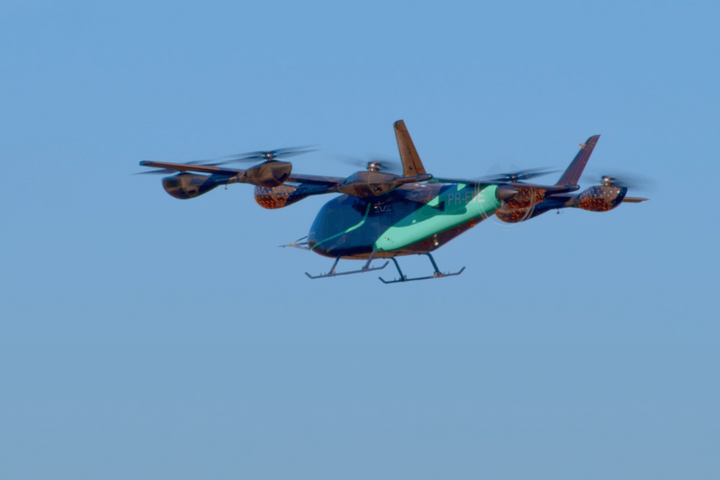
Source | Eve Air Mobility/Thiago Riboura
In early August, Eve Air Mobility’s (São José dos Campos, Brazil) electric vertical takeoff and landing (eVTOL) prototype completed partial transition flight, another milestone in its development and testing (read about June’s milestone, “Eve eVTOL prototype completes hover and low-speed flights block”).
Testing involved the activation of the aircraft’s rear pusher propeller and thus signified the start of the transition phase from vertical to wing-borne flight. The aircraft attained a stabilized speed of 27 knots and a maximum ground speed of 30 knots while the pusher was activated up to 1,200 rpm. The flight took 3 minutes and 9 seconds, travelled approximately 0.84 nautical miles and attained a maximum height of 90 feet above ground level.
“This first partial transition flight is an important milestone in Eve’s development journey [and one of the most critical aspects of eVTOL flight],” notes Johann Bordais, CEO, Eve Air Mobility. “Successfully activating the pusher propulsion system in flight validates a key aspect of our aircraft design and brings us one step closer to delivering safe, efficient and scalable air mobility solutions.”
Eve’s flight test engineering team is continuing ongoing loads and structural analyses to support future envelope expansion. Following the aircraft’s flight-testing program, the company plans to conduct datalink testing to validate radio link performance and support operations at speeds up to 50 knots.
LATEST NEWS


WHAT'S TRENDING

Data Science
5 Imaginative Data Science Projects That Can Make Your Portfolio Stand Out
OCT 05, 2022


Similar articles you can read


I teach people over 50 to build strength and mobility — here's the 3 staple moves I swear by for beginners
SOURCE: TOMSGUIDE.COM
SEP 27, 2026


Mobility Matters: Juan Mullerat, Principal of Plusurbia Design
SOURCE: COMMUNITYNEWSPAPERS.COM
SEP 19, 2026

ARIDGE and UAE Authorities to Jointly Establish the World’s First Personal Flying Car Regulatory Sandbox
SOURCE: THEMALAYSIANRESERVE.COM
NOV 30, -0001

How the Bears can Stop Bryce Young's Mobility in Week 1 Matchup
SOURCE: SPORTS.YAHOO.COM
SEP 11, 2026

Working Abroad: What Shifting Mobility Costs Mean for Expats and Global Employees
SOURCE: BUSINESSTRAVELLER.COM
SEP 11, 2026