






FCC's ban on Chinese humanoid robots may starve the US firms it aims to help
SOURCE: STARTUPFORTUNE.COM
OCT 04, 2026
Chinese Bodies, American Brains: South Korea's Humanoid Hurdles
SOURCE: CHOSUN.COM
AUG 19, 2026

Published 2026.08.22. 00:47Updated 2026.08.22. 16:59
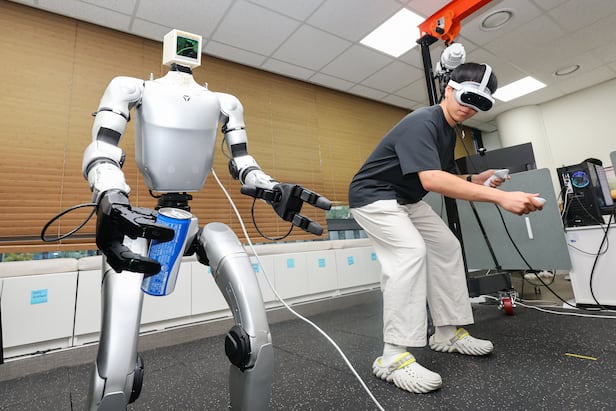
On August 20, 2026, in the afternoon, KAIST researchers operate and test the 'G1' humanoid robot from Chinese company Unitree in a computer science lab at KAIST's Information and Electronics Engineering Building in Yuseong-gu, Daejeon. /Courtesy of Choi Ki-woong
On the 20th, at the KAIST, Korea Advanced Institute of Science and Technology (KAIST) Intelligent Robotics Laboratory in Yuseong-gu, Daejeon, a researcher wearing a VR (virtual reality) headset extended their arm, and a 130 cm-tall humanoid robot mimicked the motion, picking up a beverage can on the floor and placing it into a trash bin. This was an experiment in remotely controlling the humanoid’s full-body movements via VR equipment.
The lab researches humanoid navigation and full-body precision manipulation technologies. Recently, it developed an AI model enabling industrial robotic arms to precisely insert components into narrow gaps or press small buttons.
However, the foundation enabling this relies on overseas technology. The robot’s body uses Chinese company Unitree’s humanoid “G1,” and its computing unit is equipped with U.S. NVIDIA’s AI computer “Jetson Orin.” Park Dae-hyeong, a KAIST associate professor, said, “Domestic humanoids lack sufficient reference data or repair histories, making them difficult to use as immediate research alternatives. In contrast, Chinese robots have basic walking and posture control implemented, and their research platforms are well-established. At this stage, advancing humanoid research speed without overseas platforms is challenging.”
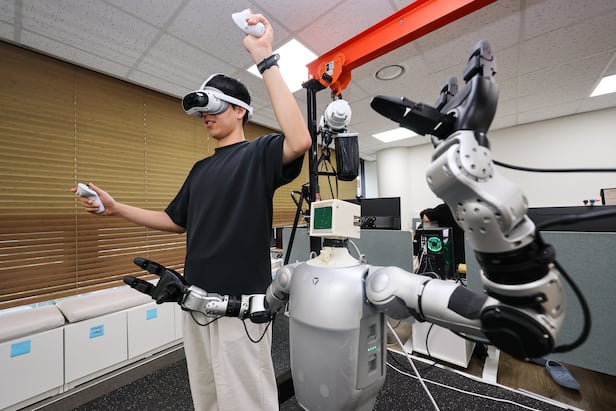
On August 20, 2026, in the afternoon, KAIST researchers operate and test the 'G1' humanoid robot from Chinese company Unitree in a computer science lab at KAIST's Information and Electronics Engineering Building in Yuseong-gu, Daejeon. /Courtesy of Choi Ki-woong
The government bundled semiconductors, AI data centers, and physical AI into “three mega projects” in June, aiming to become a “global leader in physical AI.” However, major research sites are increasingly relying on a limited structure where domestic technologies are applied atop Chinese and U.S. technological ecosystems.
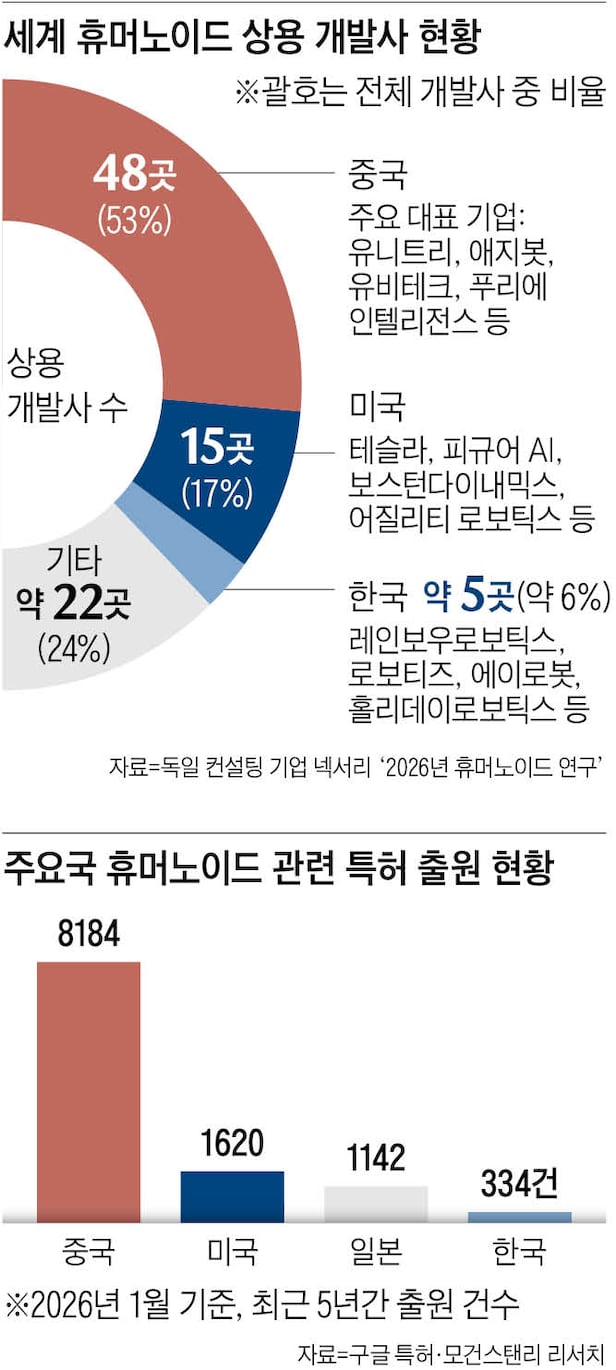
Without securing their own “bodies” and “brains” for humanoids, South Korea remains sandwiched between the U.S. and Chinese tech ecosystems. The tech industry estimates South Korea’s global humanoid market share at just 1%. Concerns arise that South Korean humanoids could become entirely dependent on the U.S.-China ecosystem if this trend continues.
Government-funded research institutions also depend on Chinese humanoids. When executing national R&D projects, they import Chinese robots like Unitree’s H1 and H2 as core research equipment.
Researchers choose Chinese humanoids not solely due to price. Unitree’s open-source software development kit (SDK) has accumulated global researchers’ code and experimental data, creating an ecosystem where new researchers can immediately begin experiments. For researchers needing results within limited timeframes, Chinese options are the most convenient.
In contrast, domestic humanoids like Robotis’ “Sapiens” and Rainbow Robotics’ “Hubo2” struggle in the market. Their relatively high costs and software environments unsuitable for research settings reduce their utility. While the government plans to invest 50.4 billion Korean won by 2030 with LG Electronics to develop a Korean AI humanoid, critics argue this is insufficient to bridge the technological gap with the U.S. and China.
If domestic humanoids are not used in research, real-world operational data, failure, and repair experiences cannot be accumulated, leading to a vicious cycle where insufficient verification histories deter researchers. Kim Dae-gyeom, a professor in the Department of Mechanical Engineering at Korea University, said, “Few domestic companies mass-produce full-body humanoids, and it’s difficult to find local alternatives meeting researchers’ standards in drive performance or development convenience.”
Industry analysts suggest leveraging U.S.-China tensions. As the U.S. bans Chinese humanoids for security reasons, opportunities may arise for South Korean humanoids and component ecosystems.
Indeed, the U.S. Federal Communications Commission (FCC) announced in July it would not grant equipment approvals to new foreign advanced robots, including humanoids and quadrupeds. It also refused approvals for robots containing communication modules or logic components from regulated Chinese companies. Given that Chinese humanoid firms like Unitree and AgiBot account for 97% of global humanoid shipments, this effectively targets Chinese humanoid products and parts. Analysts argue, “To fill the void left by China, South Korea must secure markets restricted from using Chinese products by combining core humanoid components—actuators, hands, sensors—and manufacturing data.”
Fields requiring security and trust, such as defense and healthcare, are prioritized. Song Jae-bok, a distinguished professor in the Department of Mechanical Engineering at Korea University, said, “Even if Chinese robots are cheaper, they cannot be directly used in security-critical fields. Domestic robots must first build track records and trust in these areas.”
Applying South Korea’s extensive manufacturing expertise to develop industry-specific humanoids is also necessary. Jo Gyu-jin, director of Seoul National University’s Robotics Research Institute, said, “South Korea is one of the few countries globally capable of independently producing core components like motors, sensors, and processors. Combining domestic elemental technologies, we must build a Korean hardware and software ecosystem for humanoids.” Han Jae-kwon, a professor in the Department of Robotics Engineering at Hanyang University, added, “Bundling domestic technologies into a single supply chain and scaling production could create humanoids competitive with Chinese models in price and performance.”
LATEST NEWS


WHAT'S TRENDING

Data Science
5 Imaginative Data Science Projects That Can Make Your Portfolio Stand Out
OCT 05, 2022


SOURCE: STARTUPFORTUNE.COM
OCT 04, 2026


SOURCE: THEBUSINESSDECK.COM
SEP 27, 2026

SOURCE: FUTURISM.COM
SEP 27, 2026

SOURCE: RAKSHA-ANIRVEDA.COM
SEP 19, 2026

SOURCE: THEROBOTREPORT.COM
SEP 19, 2026


SOURCE: ROBOTICSTOMORROW.COM
SEP 09, 2026