





Scientists May Have Found a Lost Roman City—and It Could Solve an Ancient Mystery
SOURCE: POPULARMECHANICS.COM
OCT 30, 2026
China turns on hypergravity machine to ‘compress’ time and space
SOURCE: SCMP.COM
NOV 17, 2024

Dannie Pengin Beijing
Published: 17 Nov 2024
The world’s most advanced hypergravity machine – capable of generating forces thousands of times greater than Earth’s surface gravity – has been switched on in China, a step that scientists say will advance their understanding of events like the rise of mountains, or catastrophes such as dam collapses.
Once fully operational, the Centrifugal Hypergravity and Interdisciplinary Experiment Facility (CHIEF) will offer a multidisciplinary science platform with the world’s largest hypergravity centrifuge, helping to solve perplexing engineering problems in several fields.
The project’s preliminary completion is a milestone in the field of hypergravity research, according to a news release on Monday by the government of Hangzhou, the capital of eastern China’s Zhejiang province, where the facility is located.
“As planned, the first phase of commissioning will take place this year,” it said in a release.

Diagram showing the scale of one of CHIEF’s three centrifuges. Image: ifeng
The project was given the green light in 2018 by China’s top economic planner, the National Development and Reform Commission (NDRC). Construction began in 2020, under the supervision of scientists from Zhejiang University.
CHIEF consists of three main hypergravity centrifuges – a machine that spins a container around very quickly so that the heavier liquids and solids are forced to the outer edges or bottom – and 18 on-board units.
The main engine of the first centrifuge – a device resembling two massive arms holding two baskets where the experimental modules will be placed – has been installed. Fabrication of the remaining two centrifuges and 10 on-board units is under way, according to the Hangzhou government.
Earth’s gravity – referred to as normal gravity – is expressed as 1g (unit of gravity), and anything greater than 1g is called hypergravity.
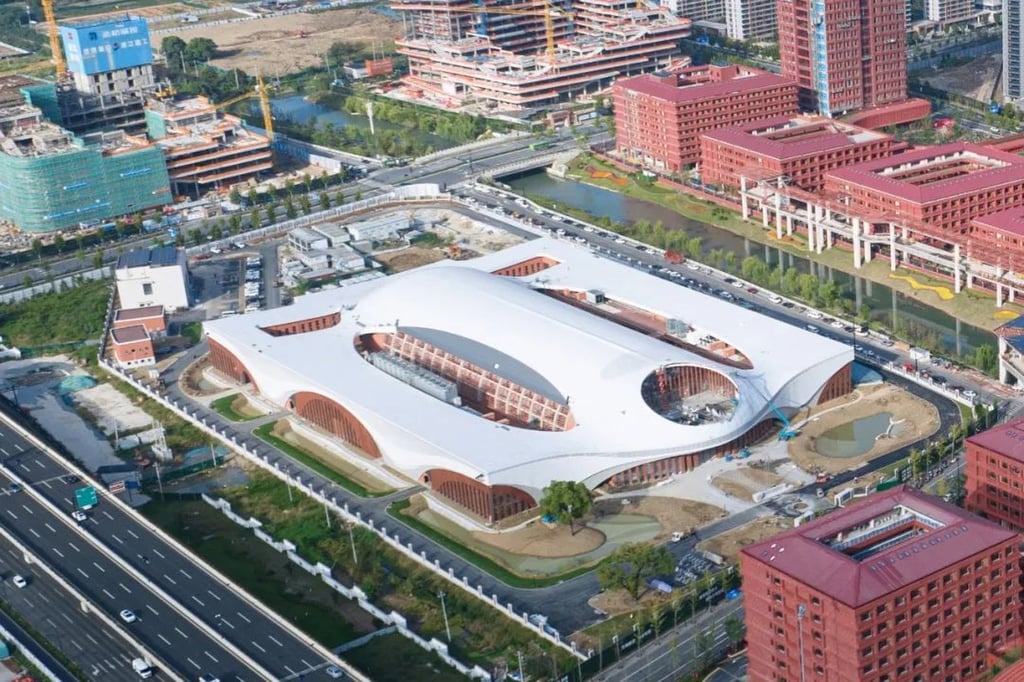
Preliminary completion of the CHIEF in Hangzhou is being called a milestone in the field of hypergravity research. Photo: ifeng
When an astronaut returns to Earth in a space vehicle, that person is subjected to 4g of hypergravity, which is equivalent to four times their body weight.
Hypergravity centrifuges are seen as a revolutionary research tool because of their ability to create extreme physical conditions that do not exist in everyday environments.
In a 2019 Zhejiang University article detailing the proposal and design for CHIEF, Chen Yunmin, a member of the Chinese Academy of Sciences and professor at the university, said that facilities like this could “compress” time and space, allowing for research into many complex physics problems and serving a wide range of engineering purposes.
“For example, scientists can observe the transport of pollutants that in nature would take tens of thousands of years,” wrote Chen, who is also the mastermind behind the massive science facility.
The world’s leading hypergravity facility was developed by the US Army Corps of Engineers and has a capacity of about 1200 g-t (gravity acceleration × tonne). The one under construction in Hangzhou will have a total capacity of 1900 g-t.
The project is designed to house six hypergravity experiment chambers, each of which will focus on a particular area of research: slope and dam engineering, seismic geotechnics, deep-sea engineering, deep-earth engineering and environment, geological processes and materials processing.
In deep-sea engineering, for example, such scientific exploration could bring natural gas hydrates a step closer to reality.
Natural gas hydrates – or combustible ice – are a frozen fossil fuel found in the seabed and beneath permafrost, consisting of water and gas, usually methane. They are considered to be abundant energy reserves, with wide distribution and offering clean combustion, making them one of the most promising alternative energy sources of the future.
The hypergravity experiments will be capable of reproducing the extraction process and simulating different extraction methods in the deep sea, providing important scientific and experimental support for optimal extraction and minimising future mishaps, according to scientists involved in the project.
According to publicly available information, CHIEF was listed as one of the 10 major national science and technology infrastructures to be built in China’s 13th 5-year plan between 2016 and 2020, at a cost of more than 2 billion yuan (US$276.5 million).
Dannie joined SCMP in 2023 and focuses on science stories in China, with a particular interest in the scientific community and societal impacts of scientific advances.
LATEST NEWS

Data Science
The Ninety Percent Problem: Unlocking Value in Unstructured Data for Enterprises
NOV 09, 2026
WHAT'S TRENDING

Data Science
5 Imaginative Data Science Projects That Can Make Your Portfolio Stand Out
OCT 05, 2022


SOURCE: POPULARMECHANICS.COM
OCT 30, 2026

SOURCE: THEGUARDIAN.COM
OCT 30, 2026

SOURCE: ONCODAILY.COM
OCT 16, 2026

SOURCE: MLIVE.COM
OCT 16, 2026


SOURCE: KYIVPOST.COM
OCT 04, 2026

SOURCE: TEHRANTIMES.COM
SEP 27, 2026

SOURCE: LIVESCIENCE.COM
SEP 27, 2026