






Blockchain Association and CCI sue Illinois over Digital Asset Tax Act – Details
SOURCE: AMBCRYPTO.COM
AUG 23, 2026


Written by

Reviewed by
Updated 18:00 EDTAugust 22, 2026
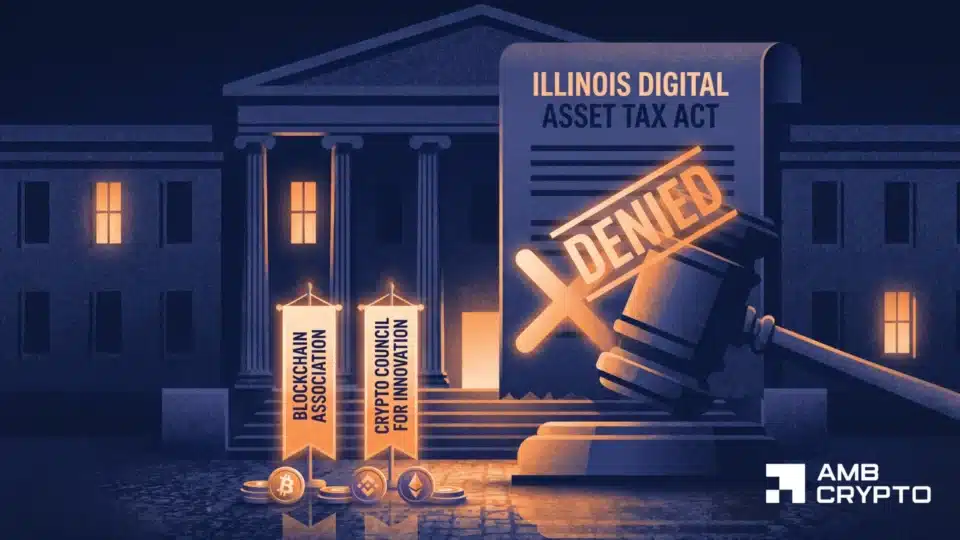
In a recent crypto market update, the Blockchain Association and the Crypto Council for Innovation (CCI) have legally challenged Illinois’s new Digital Asset Tax Act. The former argues that Illinois went beyond its constitutional authority by creating a tax specifically targeting digital-asset activity.
The press release added,
Our lawsuit asks the court to declare the Digital Asset Tax Act unlawful and enter preliminary and permanent injunctive relief barring the State from enforcing it.
AD
Illinois goes against various clauses
Additionally, the lawsuit claims that the Illinois’s new Digital Asset Tax Act goes against the Dormant Commerce Clause. For those unaware, the latter is a legal doctrine derived from the U.S. Constitution’s Commerce Clause, which prevents individual states from creating tax or regulatory systems that unfairly discriminate against or place excessive burdens on interstate commerce.
Expressing discontent on the same, Ji Hun Kim, Chief Executive Officer, Crypto Council for Innovation, said,
A tax on digital asset activity with no equivalent tax for traditional assets unlawfully picks winners and losers through the tax code.
Crypto community challenges Illinois
Their concern is that if one state creates a special tax on digital-asset activity, other states might follow and introduce their own rules and taxes. That could eventually create a fragmented system in which a company operating across the U.S. has to deal with a different digital-asset tax structure in every state.
Besides this, the lawsuit also alleges that the Illinois’ law violates the federal Internet Tax Freedom Act (ITFA). For context, the ITFA generally restricts certain discriminatory taxes on Internet access and certain forms of electronic commerce.
Expressing on the matter, Summer Mersinger, CEO of the Blockchain Association, added,
We are bringing this challenge to protect those fundamental principles and ensure Illinois stays within the bounds of the law.
Procedural challenges that are acting as blockers
That said, the crypto community is challenging both the tax itself and how it was passed. They argue that the Digital Asset Tax Act moved through the Illinois legislature within hours, without enough debate, public notice, or opportunity for affected businesses and residents to provide input.
They also argue that the law raises due process concerns because its requirements may be unclear. It’s expected for businesses and users to need to know when the tax applies and how much they owe. If the rules are vague, the groups claim that could violate constitutional protections.
States have an important role to play in fostering innovation, but that authority has constitutional limits.
This coincided with the Blockchain Association supporting the recent U.S. SEC proposal to revise the outdated clauses of Regulation NMS—Rules 611 and 610(e).
Final Summary
- The lawsuit claims that the Illinois’s new Digital Asset Tax Act goes against the Dormant Commerce Clause.
- The Digital Asset Tax Act moved through the Illinois legislature within hours.
Disclaimer: AMBCrypto's content is meant to be informational in nature and should not be interpreted as investment advice. Trading, buying or selling cryptocurrencies should be considered a high-risk investment and every reader is advised to do their own research before making any decisions.
Ishika Kumari
Journalist
Ishika Kumari is a Crypto Analyst at AMBCrypto, specializing in regulatory developments, market dynamics, and blockchain’s real-world impact. She breaks down complex protocols and legislation into practical, easy-to-understand insights.
LATEST NEWS


WHAT'S TRENDING

Data Science
5 Imaginative Data Science Projects That Can Make Your Portfolio Stand Out
OCT 05, 2022


Similar articles you can read

Grok Predicts Chainlink’s Price at the End of 2026: Will the Swift Connection Make a Difference?
SOURCE: 247WALLST.COM
OCT 03, 2026


SBC Summit 2026 to host dedicated Crypto & Blockchain conference track
SOURCE: CANADIANGAMINGBUSINESS.COM
SEP 14, 2026

Revolut Confirms Customer Data Breach Through Fake Government Request
SOURCE: CRYPTORANK.IO
SEP 14, 2026

Brazil’s exporters turn to proof of origin blockchain solution amid new EU documentation requirements
SOURCE: TRADEFINANCEGLOBAL.COM
SEP 07, 2026
